Featured

Meisner classes

Course

The next one-week intensive foundation course will run from 12 – 16 January 2026 from 10:00 to 16:00 on Monday, Wednesday and Thursday and until 17:00 on Tuesday and Friday. It will take place at OT301. This course will move at a fast pace and is intended for committed students with some acting training and/or experience. To sign up for it, please click here.

The cost for the course is €415 or €365 if you pay 20th November. Payment by instalment is available on request. You may also be eligible for a grant that will cover up to 40 percent of the cost – contact me for details.

To sign up for an online interview, please click here.

The next advanced course will start in January 2026, details to be announced. Please let me know if you are interested.

I also give private coaching classes in Amsterdam and surrounding areas. I can help you prepare for an audition, a part you’ve already booked or a meeting with a casting director or agent. I currently charge €65 for one hour of coaching within Amsterdam. If you are a current student of mine, you will get a discount. Get in touch with me and let me know what you need.

The practical part

Please note that you can only sign up for a foundation course if you have already done a taster class with me or will do an online introduction before the start of the course. To sign up for the course, or to arrange an online introduction, please click here.

If you have done Meisner training with me or somewhere else up to intermediate level and are interested in the possibility of an advanced course with the opportunity of meeting industry professionals, please let me know in the form. This is for people who are either already pursuing acting professionally or are committed to it.

If you want to register your interest in new courses and taster classes, drop me a line so I can update you by email.

PLEASE NOTE: You will get a confirmation email or an email saying the class is full. If you don’t receive an email within a few days of signing up, please check your spam folder. If you still don’t see one, please contact me!

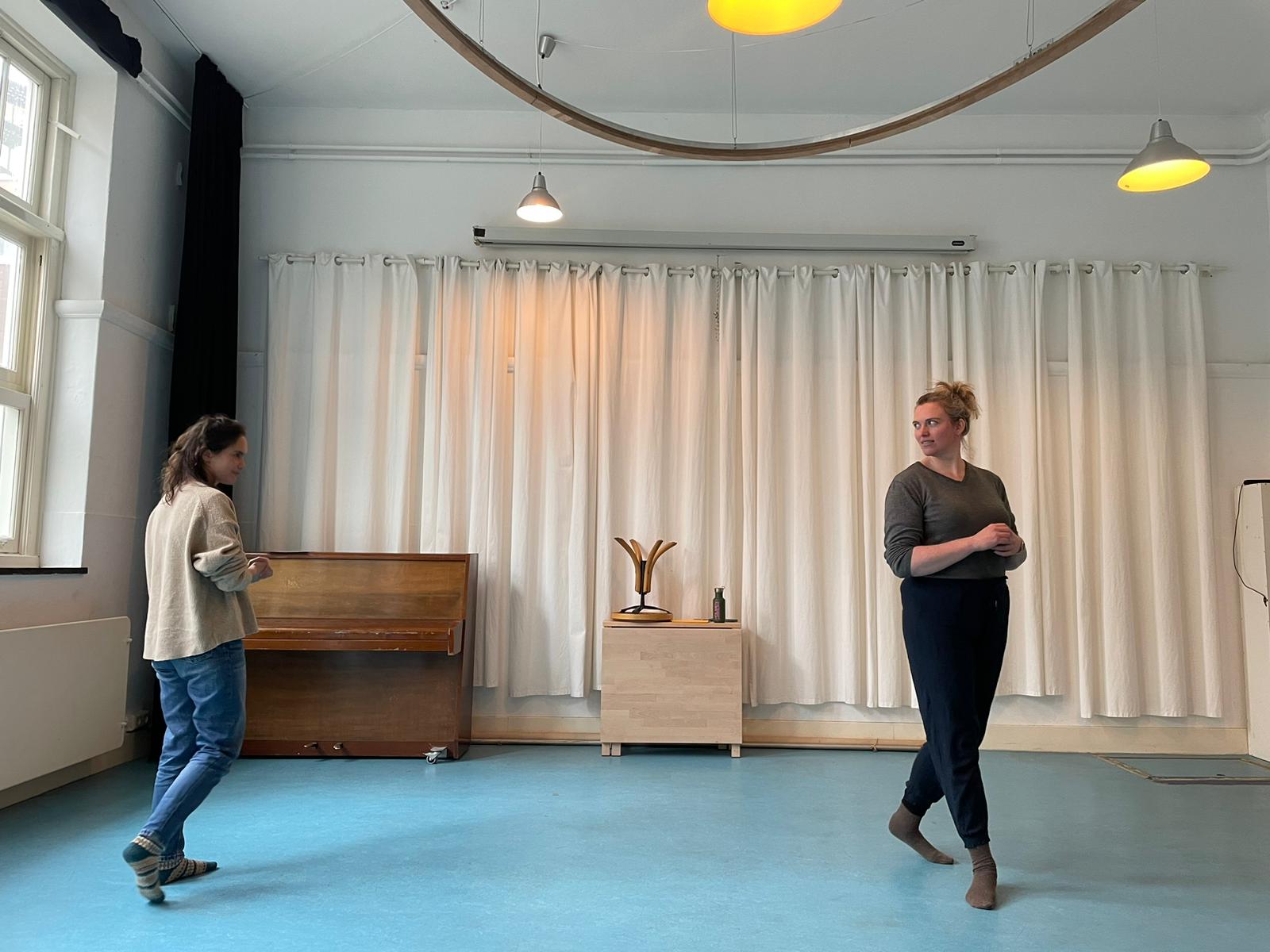
Veronica Zagi and Loveday Smith. For more pictures, go to my Instagram page.

The what’s it all about part

Sanford Meisner’s definition of acting was “living truthfully under imaginary circumstances”. Meisner believed that to achieve the ability to engage in truthful behaviour while immersed in an imagined reality the actor must learn to really listen, really observe and really do. Acting classes and directors often put so much emphasis on text work that actors can become disembodied, talking heads who are unable to really listen and respond to either their fellow actors, their own instincts or even the text.

“Act before you think – your instincts are more honest than your thoughts.”

Meisner said that “the foundation of acting is the reality of doing.” Meisner exercises are designed to get you out of your head and into your body. You will learn to unlearn the socialisation that teaches us to ignore our first impulses and to trust them instead. In other words, you will learn how to be free, spontaneous and playful – and to connect. Through the exercises of the technique, you’ll practice truly listening, observing and responding to both your fellow actors and your inner selves.

So, who was this Meisner character?

Sanford Meisner (1905 – 1997) was an American-born actor and teacher who had a troubled childhood. He trained as a pianist and actor and later worked with Stella Adler and Lee Strasberg, among others, at the Group Theatre in New York in the 1930s. Inspired by the work of Konstantin Stanislavski, the group consisted of writers, actors and directors. Through their work, they began to develop acting techniques to enable actors to create authentic performances. Lee Strasberg’s Method is perhaps the most famous of these techniques today. In the 1930s, Adler and Meisner broke away from Strasberg’s use of Stanislavski’s writings on affective memory (as Stanislavski himself did in his later years), feeling that Strasberg’s reliance on emotional recall was damaging and unsustainable for many actors. Meisner went on to develop his own method, now known as Meisner technique, to help actors achieve the authenticity and life at the heart of all great performances.

How can Meisner make me a better actor?

To unlearn bad habits and become capable of spontaneous and authentic responses, we must practice the skill of “really doing” with our fellow actors. Once we have mastered this, we can learn how to engage in imagined circumstances in a way that makes sense to us as individuals so that, once we’re performing, we only have to be in the moment. In this way, not only do we become more authentic and alive, we also connect to our own unique way of being, which is what makes each individual actor interesting to watch.

Meisner developed several exercises to help the actor develop these sets of skills. The first and core exercise is called the repetition exercise. Actors work in pairs using simple observations about their scene partners to establish an authentic connection. This goes through three stages:

Objective repetition without changes where you learn to really listen and repeat exactly what the other person says. This exercise demands that you honour your first impulse and do not attempt to censor yourself. The first actor to speak says the first thing that comes into their head; this is usually a very basic observation. The second actor then repeats what they just heard. This act of repetition means the two of you don’t have to worry about what you’re going to say next and allows you to stay focussed on each other. When we repeat, we do not try to change the words or put line-readings on them. But we respond in our own way, allowing our voices and bodies to reveal whatever they do about what the words mean to us, even if that is nothing. It is not the what that matters but the how. The repetition exercise frees us from the need to pretend to have a response, but we must also learn not to hide our responses, which can be very hard.

Objective repetition with changes This next stage is about allowing the repetition to change when we or our partners are changed – and not before. The more we are in connection with the other person and on the effect they have on us, the quicker this will happen. We learn to allow ourselves to be changed rather than forcing change upon the other. American playwright David Mamet’s writes in his book True and False “invent nothing, deny nothing, speak up, stand up …”. (What comes after the ellipsis is “stay out of school” – but that’s a story for another day.)

“What you do doesn’t depend on you; it depends on the other fellow.”

Subjective repetition with changes This final stage of repetition is when actors become so connected that they start to speak from their own point of view. In practice, this means they will say something that comes from their own perception of the situation. For example, if the other actor seems to be moved by something that has just happened, you respond to that, even if the other actor perceives it differently. 

Click here to see Meisner teaching the repetition exercise. This was filmed late in his life when he had had operations on his throat for cancer. He is speaking through a special machine. This particular exercise is called the three-moment game where the first partner starts by saying something deliberately provocative to the second partner and then works off the second partner’s reaction, whatever it is. It is designed to make crystal clear the process of listening, responding and working off what you get in the moment. Once you get the hang of this, you will learn to work off whatever you get in the moment, including the subtlest, micro changes in your partner and yourself, and to be able to go wherever those moments take you.
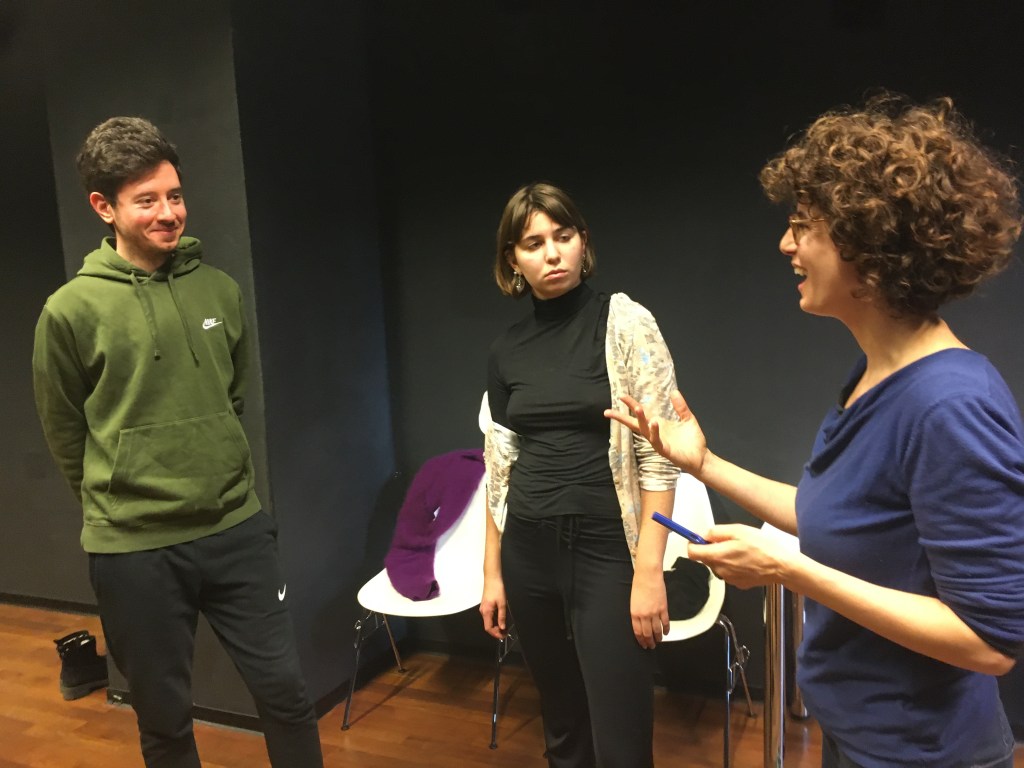
Intro to Meisner workshop, Berlin

“Acting is behaviour.”

When you are truly present and in your body, you will find that your whole body becomes more expressive. When you are moved, often you will literally move and behave in ways that are surprising. You learn to experience the space you are in as an extension of yourself and your scene partner. When we come to do scene work, the physical freedom that we have found through doing the repetition exercise will become invaluable.

As actors, we want to come away from a class knowing we have learned something we can apply when we are outside class. If you show up and do the work, you’ll walk away with a set of skills you can apply almost immediately to every acting situation.

Independent activity class, Berlin

Who are the classes for?

The classes are intended for actors at any stage of their training, including those with no previous experience of Meisner technique. Please note that the classes will be taught in English, but it is always possible to work in Dutch (or another language) with your scene partners if that’s easier for you.

Non-actors curious to see what the technique is about are very welcome to audit the class for a reduced price. Please let me know this is what you want when you book.

What will a Meisner technique class be like?

Classes will be open to a minimum of six and a maximum of ten students so that everyone gets plenty of time on their feet. Observing others is also part of the learning process and you will be encouraged to comment, ask questions and make notes. You will work mostly in pairs. Classes usually last three hours.

Class will always start with a simple movement technique and a voice release exercise to make sure you are completely connected to your whole self. We will then move on to the repetition exercise, the core of Meisner technique. Through the various stages of the exercise, you will learn to truly listen to and observe both your fellow actors and your inner selves. This exercise is the bedrock for all the later exercises, such as Knock on the Door, Independent Activity and Emotional Preparation and, finally, scene work, and can be returned to again and again.

These classes will be accessible but also demanding. Meisner technique requires you to get to know yourself, your acting tics, your vulnerabilities and your defence mechanisms. This can be confronting, but as you do the exercises, you will quickly understand why this matters and experience the benefits of doing the work.

Meisner technique demands something very simple of the actor: To connect to their authentic selves and to their fellow actors. Like all simple things, this takes time, practice and dedication. Commit to the work and you will grow, not only as an actor, but as a human being.

Follow me on Instagram.

Follow me on Facebook.

Featured

Taster classes & courses

Taster classes

Please fill in the form if you would like to sign up or be kept updated on future taster classes.

Courses

The next one-week intensive foundation course will run from 12 -16 January from 10:00 to 16:00 on Monday, Wednesday and Thursday and until 17:00 on Tuesday and Friday. It will take place at OT301. The course will move at a fast pace and is intended for committed students with some acting training and/or experience. To sign up for either course, please click here.

The cost for the course in January is €415. There is an Early Bird price of €365 if you pay by 25th July. Payment by instalment is available on request. You may also be eligible for a grant that will cover up to 40 percent third of the cost – contact me for details.

To sign up for an online interview, please click here.

The next intermediate course will be from 10th – 14th November. The course costs €365 including btw. You can sign up for it here.

The next advanced course will probably start at the end of January, tbc. We will meet twice a week for three hours over a period of six weeks, possibly with one week off in between. It will take place at OT301. The price for the whole course will be around €1400 including 21% btw. Please contact me if you want to be considered for this course.

A note on attendance: My classes are intended for people who are committed. In my experience, commitment is the single greatest predictor of progress. Whether you have little or considerable experience as an actor, I expect you to attend all classes unless you are sick or there is some other unavoidable situation. If you know you are going to miss classes due to holiday or work in advance, it is not advisable to take the course as missing more than one class is likely to have a significant impact on your progress. If you are taking a course and do miss a class due to illness or other unavoidable reasons, you are welcome to make it up by attending another course’s class, as long as there is another one running in the same period as yours and you ask me first. Current students are always welcome to audit any other classes I have running in the same time period.

In the intermediate class, you will also work with a scene partner who will depend on you to do their side of the work. In addition, in all groups there is an expectation that you will practice outside the class with your fellow actors; in the intermediate group it is required.

Drop-in classes

I am now holding drop-in classes. These are for people who have completed a foundation course with me or done Meisner training elsewhere. The classes run for two hours, usually from 10:30 to 12:30 on rotating weekdays announced a week in advance. There are a maximum of six people in each class and they take place in Overtoom 301. You can choose what to work on, including simple repetition, independent activities, emotional preparation, relationship scenes or text. You will sign up online up until one day in advance and classes from 2026 are €30 payable in cash or tikkie on the day. I will introduce a strippenkaart system once it’s up and running. Please drop me a line if you are interested so I can keep you updated.

Cost: Currently, all Meisner foundation and intermediate courses cost €365 including btw if you pay a few weeks in advance or €415 if you pay later. You can arrange to pay in instalments on request.

Cancellation policy: The deposit is non-refundable unless I cancel the course. If you cancel a course up to one week in advance, you will get a 100% refund on everything except the deposit. If it’s less than a week but more than two days, you will get a 50% refund. After that, you will receive no refund but if I was able to fill your spot, it may be possible to transfer to another course at a later date.

If you have any questions, please get in touch.

Whiplash and other adventures

Here are the things I’ve started doing again since my last post: Teaching; civilly disrupting; worrying about what I’m going to make for supper and occasionally actually making it; and, when I’m not doing those things, coaxing myself back into writing mode so I can get on with the funding application for my Rehearsal for a revolution performance project and maybe even the sit-com that is threatening to become a sit-forever-on-my-com(puter).

I also received some wonderful things in the post recently, including a piece of self-made art from one of my nieces, a fantastic play that I saw in London called Word-Play by Rabiah Hussain and my certificate from the Meisner Institute in Los Angeles certifying that I am now a designated Meisner teacher. Isn’t the post wonderful?

Last month was difficult as I got a severe pain in the neck from standing up to the fossil fuel industry. It all started in July when I went to London and back by bus for a school reunion. I try not to fly and I’d left it too late to book an affordable Eurostar ticket so the bus was the only option. The school reunion bit was great, but everything else about the trip was enormously stressful and on the way back I was thrown about so much in my semi-sleep that I ended up with a very stiff neck and left shoulder. Camping and hanging out with my beloved and bonkers family over the summer didn’t seem to improve matters so, a few weeks ago, I finally went to see a physio. I explained the situation and she set to work. It got a bit better but on my following visit I told her that I’d been stressed as I had been in the Hague getting battered by water cannons and pulled about by police during the Extinction Rebellion blockade of the A12 motorway. We have been going back every day since September 9th. (At this point, I had personally been three times.) I’d been quite nervous revealing this to her as of course people don’t always agree with our tactics but felt I needed to tell her, partly so she knew what I was going through and partly because it’s important to me to be open about what I do and why I do it. Fortunately, she wasn’t horrified by my actions. The next day, on Prinsjesdag, the day the king announces what the Dutch government plans to do (like the Queen’s Speech in the UK), I was back again and this time I was in a long dress in honour of XR’s own version of Prinsjesdag. After sitting on the ground attempting to shield myself with the one rain-proof thing I had remembered to bring (a re-useable plastic bag) I stood up and started dancing to keep warm and keep up my spirits. At this point, the cannon blasted me so squarely in my belly that I lost my footing but at the last second, I righted myself and placed by foot firmly back on the ground. This delighted me so much that I continued to pull what I thought were some very clever moves, making me feel like a Ninja. The next morning, my neck announced to me in no uncertain terms that I was, in fact, a moron. So, to summarise, the fossil fuel industry gave me whiplash, but I’m still standing, yeah, yeah, yeah! Even if my neck wishes I’d just have a nice lie-down.

Meanwhile, in the UK, Rishi Sunak announced his “I’ve scrapped it” U-turn on any measures to ensure our children have a future. The thing that terrifies me most about this is that his story that he’s saving the British electorate from the dictatorial imposition of expensive and unnecessary policies, isn’t only a lie, but will actually open the door to genuine eco-dictatorship. When our planet is past the point of no return, governments will come into power that brutally ration energy, food and travel for those who already have very little while allowing the powerful to continue to take whatever they want. Citizens’ assemblies (XR’s third demand) would allow us to come together to decide how we fairly and effectively distribute the burden among ourselves and this is why no Tory government will ever allow them to happen.

The world is a difficult place sometimes and I rage at all the injustice in it. At the same time, I am lucky enough to experience its beauty every day, even if that is just the way sunlight breaks through a cloud and lends the world its gold for a few moments. Teaching the fourth class last week, I realised that we had reached that moment in each of the three courses when the students struggle to understand what we are doing and I struggle to remind myself that this, too, is part of the process. To be truly authentic is to learn the ability to really listen and take in, and take personally, what the other person is communicating to you.

In the Friday’s foundation class, which I am teaching in the luxurious cinema space at OT301, we had a visit two weeks ago from Meisner-trained actor and all-round lovely human being, Lee Kaplan. Lee had some really interesting insights about choosing an activity that “lights you up” for the independent activity exercises. The aim of this exercise, which gets more elaborate as you progress, is to get actors used to working off each other truthfully as they have already learned with repetition, under a “circumstance”. Meisner defined acting as “living truthfully under imaginary circumstances” and developed the repetition exercise as a way to help actors get out of their heads by putting their attention on the other person, thereby releasing spontaneous behaviour. So now we learn to take our attention off ourselves even further by fully doing an independent activity (really putting our attention on it) and responding to the other person. The activity can only be done by you – your scene partner is not allowed to help, hence the “independent” bit. It can be anything but you must really do it, so you must bring in everything you need in which to complete it. You must also do it in a set amount of time, e.g 15 minutes, and to a certain “standard of perfection” so that it’s clear to you if you succeed in your activity or not. And of course, the point of this exercise is not whether or not you complete the activity but what the doing (or not doing) of it does to your behaviour. Perhaps the activity is a pot broken into many pieces that you are going to glue together so that it’s completely whole again; perhaps it’s a song on the piano that you want to perfect or a bike tyre that needs replacing. The more difficult our task, the more it will absorb us and cause us the struggle that creates inner life. Students often find it hard to bring in activities that truly “light them up”, either bringing in tasks that are too easy of that they don’t really care about. (For me, this part of the work was relatively easy as I suck at so many things and desperately want to be better at them!)

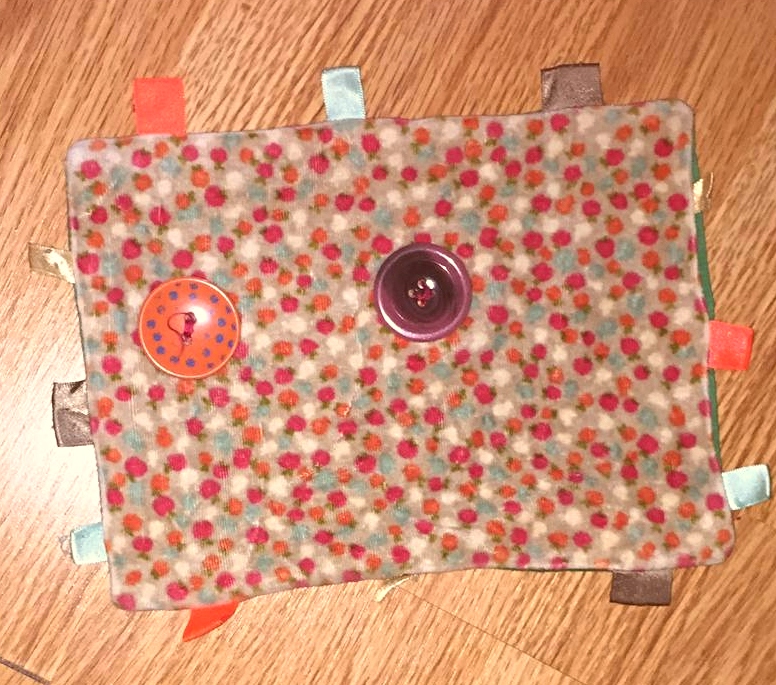
If you learn to commit fully to doing your activity, once you bring in the justification for doing it, alway as imaginary reason related to a real person in your life who has great emotional significance to you, you will find yourself completely absorbed. I promise you this works and here’s the reason: Your subconscious cannot tell the difference between an imaginary circumstance and the real thing. Think about how you can bring yourself to a state of tears, anger or great joy through a daydream. This is precisely the way you must come up with your activities and the crafting for them in the later stages of the exercise. Above, you can see one of my first attempts at this exercise: sewing three buttons onto a cloth that belongs to my daughter, who at the time was two, to comfort her while she was in hospital for life-saving surgery. I’d set it up so that I had to finish the sewing and get to the hospital in 20 minutes. The daughter and the cloth were real; the hospitalisation was not. The buttons were spare buttons from a cardigan I have which she loved. The sewing was a struggle for me and at a certain point my scene partner told me truthfully (by which I mean, from her point of view) that the cloth looked ugly … and I burst into tears. When students say, “But I don’t know what activity to do!” I say: No one but you can know what will really bring you to life, so shut down your phone, go for a walk and allow yourself to dream a little dream that is entirely personal to you.*

After Lee had left, some of the students and I had a conversation about what it is you need to progress in the Meisner work. For me, it’s primarily commitment. Progress can often seem frustratingly non-linear and while a student may think they’ve “got it” one week, the next feels like a slide backwards. The truth is, every time is an attempt and the more attempts we make, the more we build our skills and ability to stay in the moment, even if that’s by learning to recognise when we are not in the moment. Keep turning up, keep trying, keeping processing and you will progress.

The intermediate class, otherwise known as the Phenomenal Thursdays, are a case in point. There were a couple of people in this class who started with me in a different acting class and have made such incredible progress that I barely recognise them, even though I do recognise the thing in them I saw the first time I met them – commitment. This group is now learning to improvise within an imaginary relationship, continuing to use the skills they learned in the foundation course: listening, putting your attention on the other person, responding authentically moment to moment and using emotional preparation for the first moment in the scene. There has been some beautifully compelling work with actors learning to be vulnerable and compassionate, as well as safely releasing emotions like anger and despair.

An Italian artist friend of mine, Domenico Magnano, recently asked me to translate the lyrics of a song/poem he has written for his co-creater and lover for a video that forms his part of their performance art project Yes, I do at the Niewe Dakota gallery. It is a beautiful poem that reveals him completely. Reading it, it struck me that what makes an artist an artist is not their talent, but their need to share their vulnerability, in whatever form it takes. It is a generosity that often comes from deep pain and leads to more, but continues to be present despite this. (You never really develop a thick skin, because if you did, you couldn’t be an artist anymore.) At the opening of their show his partner, Marieke van Rooy, performed her part of the project, donning especially-made majorette-like clothes doing a dance and singing “Be yourself and do it”. There were stares of incomprehension from the crowd when she started and afterwards too but she remained completely committed throughout and was mesmerising to watch. When she finished, she created a bed using a cloth and some shelves, hid under the cloth and then started telling us a very personal story about her father’s funeral.

So now when people ask me what you need to become an actor, I say: Thin skin, commitment, and an intense desire to share your authentic self. Mix well and add plenty of hard work and daydreams to taste!

*And I am very happy to say that, two weeks on, the students have brought in some wonderfully life-inducing activities that have taken them on journeys from deep sorrow to anger to laughter and back again.

UPDATE: I meant to post this a while ago so it’s now out of date. I am incredibly happy to say that after 27 days of blocking the A12 highway asking for an end to fossil fuel subsidies, the Dutch parliament just passed a motion to ask for scenarios for two and seven year time horizons which need to be presented before Christmas. We’re not there yet, but hopefully this is the first moment that will bring us to where we need to be.

Sleepless in Sterdam*

This week I “worked off” a lot of people’s behaviour. I started out my week by wondering what all the noise in the street was, deciding that it was football-related. As the week went on, so did the noise, even though there were no big football matches going on. I finally found out from some neighbours that there was a nine-day Moroccan wedding celebration going on a few doors down. The bride was 18 years old and getting married to a man from Utrecht. My neighbours told me that there had been a lot of hugging and crying between mother and daughter and I joked to my almost-ten daughter that she certainly wouldn’t be allowed to move away that far if she ever got married. (I wasn’t actually joking.)

It has been incredibly hot in Amsterdam so we have had all our windows and doors open, which allowed some heat to go out and a whole lot of noise to come in. In the evenings, I danced on the balcony with my kids but when I tried to sleep, it was less fun.

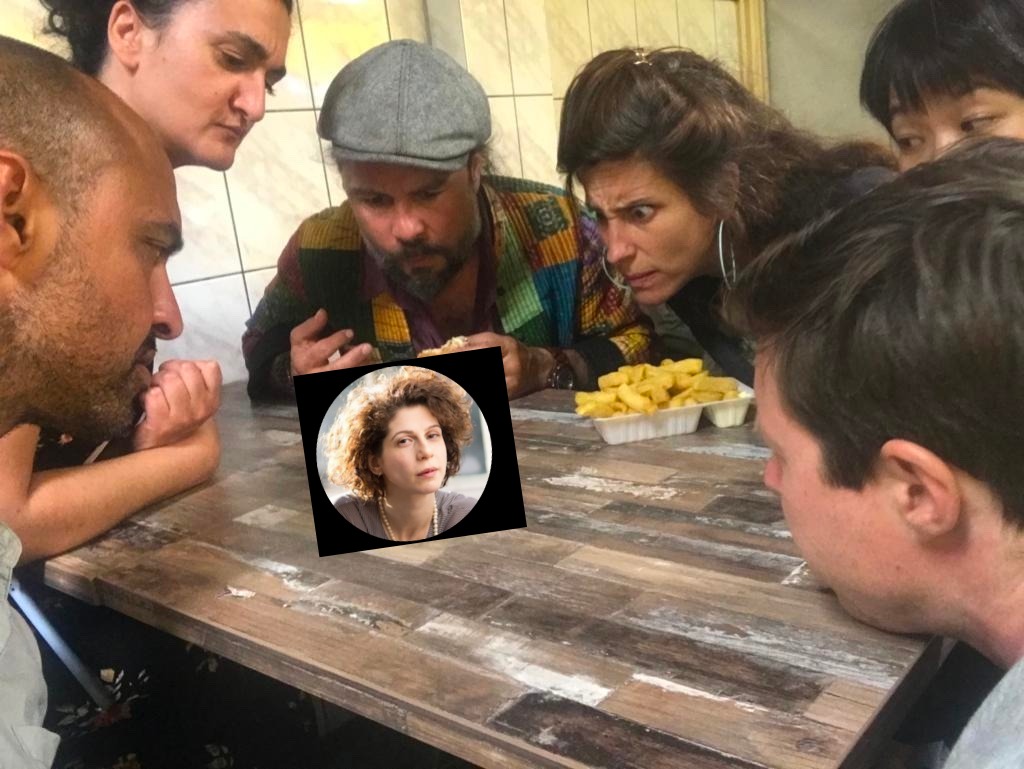
Thursday night was the last class of my wonderful Thursday evening class. (You can see them in the photo below. Two of them were unfortunately not there and we missed them!) We have had our ups and downs, but they are really a wonderful lot and made huge progress in our ten sessions together. I am very glad that many of them are coming into the advanced class in September. They did cold readings of short two-hander scenes, then learned a few lines the Meisner way and did them again off-book. They stayed open and connected to each other, resulting in some very moving, funny and unexpected moments. Afterwards, they decided to go for a drink and chips and despite a very strong desire to go with them and my love of chips, I forced myself to go home and try to sleep. But the music kept on, accompanied now by roaring motorbikes. Having just learned the week before that I had lost hearing in my left ear, I was surprised by just how much I could hear and worried that the bikes might cause me to lose more.

“What’s this?! We ordered chips!” L-R Pablo van Wetten, Robi Modena, Cherif Zaoauli, Josefina van de Donck , Grace Chang-Byrne, Ana Uzelac and Sam Morris.

On Friday night I did front of house for Orange Theatre Company, Amsterdam’s wonderful English-language theatre company of which I am proud to be a member. The journey there was infuriating as Amsterdam is in the process of trying to reduce the number of cars on the road, which apparently means making life for cyclists hell as most of the main and many random side streets are closed. I think the current mayor may not be the best at logistics … At this point, my rage was at such a pitch that I was ready to throw some of the insanely large SUVs clogging up the streets into the canals. (I know now for sure that when I hit my 70s, I am going to be one of those fantastically grumpy old ladies that clears a room in seconds. I can’t wait.)

The play is called Sweet Sixteen and is an English translation of a Dutch play by Casper Vandeputte. It’s about two teenage sisters, one of whom has committed suicide, and their attempt to make sense of life, death and everything in between. There was some great music in there too. No matter how many times I go to the theatre, I never remember to bring a hanky, which is exceedingly stupid of me as I always end up weeping, whether from sorrow, joy or fury. If I don’t weep, it’s a really bad show. Well, obviously I wept for all of the reasons. Buckets. And had to dash home, in a mess of tears, weaving my way through blocked roads and oblivious tourists, feeling more homicidal by the moment.

Once back in my hood, I encountered a performance group making use of the local market square, or plein in Dutch, which now cleared of market stalls turned out to be a circle, that most theatrical and equality-inducing shape. I fantasised about doing the performance piece I am working on there before moving on through the cooling air. Phrases from T.S. Eliot’s Four Quartets wandered through my head colliding with Billie Eilish in a not unpleasing way. “Humankind cannot bear very much reality/When we all fall asleep where do we go?” I was desperate to find out the answer to that question but the music kept on blasting and sleep never came.

Looming up on Saturday was a dreaded headshot session. I struggle with these like many actors and I was trying out a new photographer too. Somehow, I always end up not sleeping the night before and going in looking more beast than beauty. (To be clear, I am totally down with playing the beast over the beauty, but even a beast needs sleep to be at its beastliest.)

In the morning, I stumbled in to my photoshoot with all my worst fears realised. The home-made black banana and oat face mask I had made that morning didn’t deliver the promised miracle, although it did make my children scream in terror, and my hair was not co-operating with me. I turned up trailing my tail of woe to the photographer, who instantly gave me iced vegan coffee and a look of sympathy. Dear reader, she was just what I needed and I can heartily recommend her! She took on my mess of a face and Bellatrix hair and made me smile despite it all. She also played more great music the whole time she snapped away and made the beast as human as it was possible to be.

Still, the beast raged on inside me. That evening, a friend and I went to Hez ya Mez, a DJ’d night of Middle Eastern music and gender-bending belly dance at the fantastic Mezrab. The irony of paying to dance to Arabic music after having danced to it free all week long was not lost on me. Of course, it wasn’t really free – I had paid with my sleep and by this point I was in major sleep debt. The evening was wonderful – incredible hip action by the male belly dancer loosened the hinges of our jaws to the floor – and we wafted our hands joyfully through the hot air. After a while, we headed out for some cool. As we chatted, I observed someone casually throw their cigarette butt into the drainage system. NOT COOL. I was angry with myself for not having intervened in time but I resolved to start banging on about it to everyone from now on to make up for it. Cigarette butts are made of plastic and toxic heavy metals so they do not break up in the ground and cause serious damage to our ecosystems. They are the biggest source of micro-plastic in the world and people who would never dream of throwing anything else onto the ground chuck their fag butts down without a thought. Heartbreakingly, birds and other wild life end up eating them. In 2019, someone photographed a Black Skimmer carefully feeding its chick a cigarette butt. I know many highly educated and very caring people who have no idea about this so don’t feel bad if this applies to you, but please pass the word on. A move to ban the filters (which actually offer little to no protection, surprise, surprise) is on the way in the EU; in the meantime, we must dispose of our butts in an appropriate fashion.

I went home at 1am and finally had a half-decent night as the wedding was the next day and the bride was certainly not going to get married looking like a beast. But I was woken early the next morning by the fierce heat and more noise than even before. The djembes and the dancing were in full swing and many neighbours who hadn’t escaped to the seaside were out on their balconies, waiting for a glimpse of the bride. (We never got to see her. My daughter wondered if she’d escaped out the back …)

The last straw came when four or five motorbikes roared ceaselessly under my window and firecrackers were let off making the noise level truly unbearable. I marched into the street, determined to ask the family politely but firmly to tell the motorbike riders to stop. The first couple I approached outside the bride’s house, now decorated with a flowery arch, was an older couple. I congratulated them on the young woman’s wedding and said I would really appreciate it if the motorbikes stopped trying to break the sound barrier. They nodded sympathetically and told me it would soon be over. I could tell that they wanted it to be over themselves. They were clearly not in a position to ask the motorcyclists to pipe down and the bikers themselves were off on one of their journeys at that moment. I approached a slightly younger man and asked him if he could tell the bikers to take a break. He was not happy. He told me to shut up, go home and mind my own business. There was a very strong whiff of misogyny about him and it made me very angry indeed. I told him firmly that he did not get to tell me when to speak and when to shut up. A young man stood near by. I told him how I felt. He said not a word but looked at me full of kindness and understanding, even though my Dutch was slipping more and more into English. At this point, the other man started yelling angrily at me again and told me to go home if I didn’t like it. To my point that the noise was driving the whole street mad, he shouted “I don’t care!” I turned to the young man, who was still patiently standing next to me and was now motioning to the other man to calm down. “This,” I said, “this I-don’t-care is what’s breaking the world!” The young man nodded his head in what looked like agreement. The older man walked away and, shaking my head like a disgusted grandma, I started to walk away too. I don’t remember exactly what happened next, but I ended up in another altercation with a woman who told me she also “didn’t care”, that I should go home and stop bullying her and that it was “tradition”. I didn’t think it was anyone’s tradition to ruin their neighbours sleep but of course I didn’t come up with that until after I’d stormed off, shouting a few sarcastic phrases in English and Farsi to anyone who stared at me. I walked round the corner heading for the cooling atmosphere of the park and noticed a stream of cars waited to turn into our little street, honking their cars joyfully. Only then did I realise that it really was over and that I know how to pick my moments …

Of course, I am not proud of having shouted or of not having tried to have the conversation sooner. (Although I had earlier tried to communicate with the bikers from my top-floor street-facing balcony; unsurprisingly, they either couldn’t or wouldn’t hear me). I learned a few things from this experience. One, there’s only so much noise I can take before I break. Two, misogyny really winds me up. Three, there’s a conversation to be had with my neighbours (although I have a feeling the loud bikers were from the groom’s family). Four, if I lived in the Islamic Republic of Iran, I’m pretty sure I’d be dead by now. And five, it only takes one act of listening to diffuse a situation. I will forever be grateful to the young man who nodded his head while I ranted, not just for his kindness in that moment, but for reinforcing my faith in humanity. Even if only a few people in a group are willing to listen, a way forward is possible.

The week done, I noticed that a lot of people had signed up for my Meisner taster classes in July. I look forward to teaching the new students in September and all the moments that will bring. In the meantime, there is lots to do. Including going to my first ever school reunion in Oxford on Saturday. I will be taking an overnight bus from Amsterdam to arrive in London on time. I suspect my sleep debt is about to sprout compound interest …

*When my daughter was born, the city of Amsterdam had undergone a rebranding and gave all babies a little square cloth with “I amsterdam” written
on it. My British family found this enormously chucklesome and called her and the city Sterdam for a long time after.

Crocodile tales

I got an upgrade to my mental health condition. I no longer have imposter syndrome, I have imposters’ syndrome. I am now an imposter in multiple fields of activity. Impressive, right?

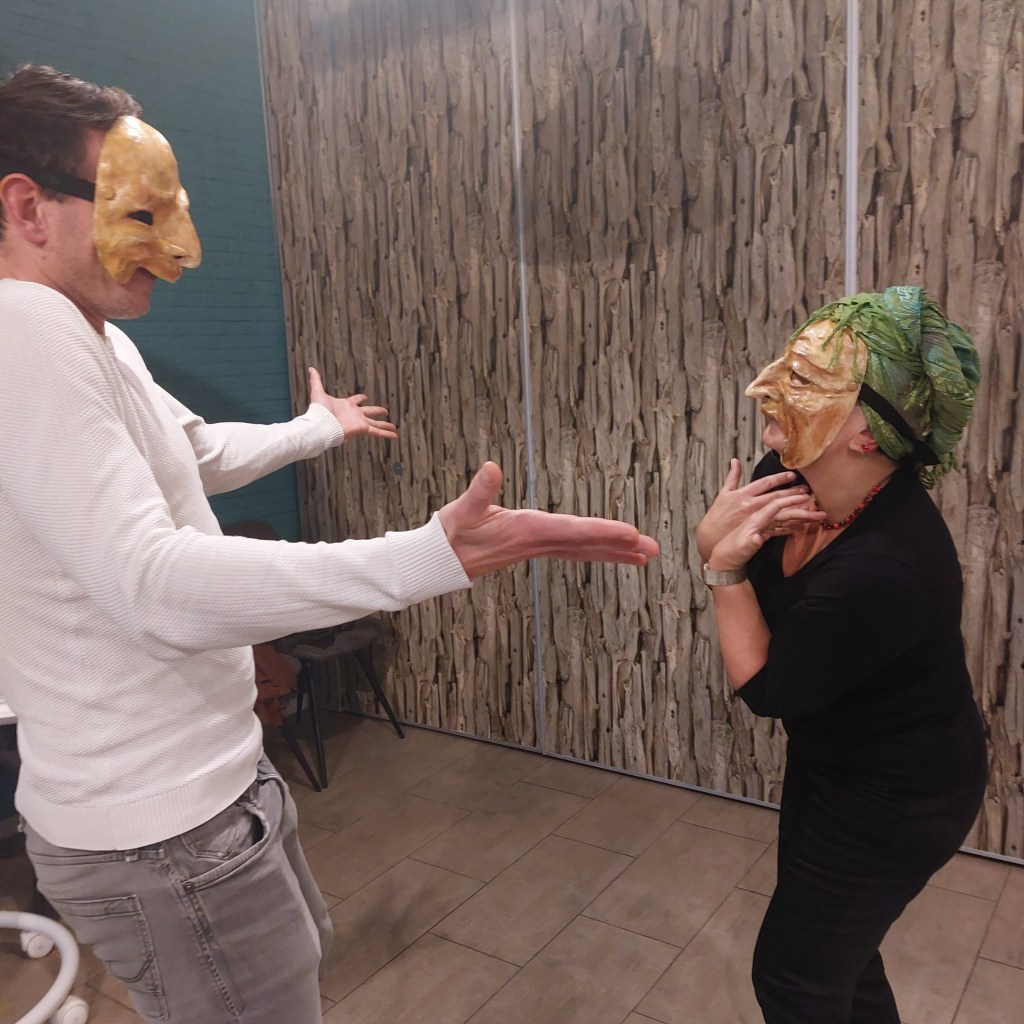
Last Saturday the wonderful master of Mask, Grainne Delaney, came to the studio at Tugelaweg 85 and taught a workshop to some of my Meisner foundation students. She led the students through some breathing and vocal exercises and then some slow-mo fighting to get us all to slow down and become connected with our bodies. It was also a lot of fun. We then gave her a demonstration of the repetition exercise, which she had never seen before. She taught us how to “read” the masks, half-masks made by Juan C Tajes, and what part of the body each part of mask corresponds to before encouraging the students to discover the personalities of their masks and bring them to life physically and vocally. The last exercise we did was a combination of Meisner improvisation and Mask, which led to a hysterically funny and yet also moving performance posthumously entitled “The Hospitaal!”. I had given one of the actors, Amanda Lee, the double instruction to try to remove one of the other actors (Ady van de Plas) from the scene, while engaging the third actor (Grace En-Tien Chang) in very vigorous repetition, calling out all her behaviour. Amanda responded to this wonderfully, constantly pointing out the most absurd truths in the nasal whine induced by her mask. Ady’s character was apparently in terrible pain and Grace kept fruitlessly trying to help him, so the whole story revolved around Amanda telling him to go to the hospital while the other two, who wanted of course to carry on playing, blocked her at every turn. The straight-to-the-point style of the fool archetype played by Amanda worked perfectly with the Meisner instruction to always work from the truth. And as we all know, the truth might hurt but it can also be incredibly funny.

A few nights ago, I couldn’t sleep. I was struggling with various problems, one of which was how I had bitten off more than I could chew by deciding to lead a group of dancers in a devised piece about the climate crisis and our collective inability to get to grips with it. (Working title: (Rehearsal for a (r)evolution.) All sorts of thoughts wandered through my head, looking for something to connect with. Most of them wandered out again, but some hung around despite the vacuous atmosphere. At some point, a crocodile took up residence. A bartender swiftly followed. The crocodile had a few drinks and told stories about all the times he’d almost caught hold of Captain Hook before the alarm clock in his belly went off and foiled him, once again. I was enjoying the whole thing immensely when, suddenly, my alarm clock went off and I realised I had to get through the day, all over again. Still, the crocodile stayed with me and is now a pivotal part of the project.

In the middle of all this, I suddenly had an image of a random woman demanding funding to direct a team of crack astrophysicists in how to discover a new solar system. I chuckled silently. And then realised I was the random woman. And that I don’t even know how to define a solar system. Mid-chuck-sob, my husband woke up to remind me that some people liked to use the night for sleeping and could I please wait till morning?

Later on that week I had a very difficult experience in one of my classes when one student did something that inadvertently upset another. I learned a lot of lessons, the most important two being that I have to enforce the rules of the Meisner technique more vigilantly and that I need to create a brave and safe space. This means giving actors the permission to take risks and also permission to remove themselves from a space in which they feel at risk. It is about the difference between trying to protect actors from difficult experiences (which I cannot always do) and giving them the agency to call their own boundaries.

Luckily, I have a wonderful sounding board in the group of Meisner teachers I study with online in L.A. every Sunday evening. As well as the joy of working through the exercises together – last week I played Medea in a therapy session – they keep me sane when things go wrong which, inevitably, they do.

In the meantime, my children are spending their lunch breaks swimming, random indoor cats come to visit us because all the balcony doors in our street are open and I am hiding from the sun because the heat makes me ill. On Wednesday, I will brave the midday heat to travel to Den Haag to start another project around the nitrogen crisis (Stikstof crisis) here in the Netherlands. Reading about the terrible drought in Spain, the drought and rains cycle in Kenya and the wildfires in Canada, my faith is in short supply at the moment. But I know I am incredibly lucky to have the luxury of hiding inside in a relatively cool (27 degrees inside!) apartment. And so, this hot Monday afternoon, this multiple imposter raises her iced elderflower drink to you, cheering on the swift demise of capitalism, the longevity of connection and the survival of crocodiles, fictional and real. Stay truthful my friends, for truth is beauty and beauty truth.

Meisner and Mask workshop with Grainne Delaney. L-R Grace, Ady and Amanda.

Could you be my miracle?

The taster classes are there to give potential students an idea of what the Meisner foundation course will be like but also so I can see what kind of people I will be working with. All sorts of fascinating things happened in my last two taster classes. They were both very small and extremely dynamic groups and I can’t wait to work with them in my new course starting this Wednesday morning.

Unfortunately, the same problems I had when I started the first daytime course beset me now. The daytime class is a hard one for people to commit to for obvious reasons. At the last minute, I had to change the day from Tuesday to Wednesday to allow more people to join but I still don’t have enough students.

The space has also been a problem. I followed a neighbour’s advice about a new place opening just down the road. I’d been on the phone and laptop all morning trying to find a space so I decided just to go and check it out. I got there and had a look. It looked like it could be the perfect spot … except the builders hadn’t quite finished it yet. Fine, I thought, no space, not enough students: it’s just not meant to be. I cycled towards the park determined to cancel the course and just enjoy the classes I already teach. As I cycled, a building caught my eye. It looked like a community theatre. I got off and went in. It was indeed a theatre. I asked the man behind the bar if it was available for rent. He went and got the woman who ran the place. While he was gone I thought, well, it won’t be for rent, and if it is, not for ten consecutive Wednesdays, and even then there’s no way I can afford a space like this … Dear reader, I got the space.

This morning I thought I had nowhere and now, amazingly, I have three, affordable and lovely spaces … but not enough students. It’s too late to do much else except pray for a miracle. The night before the start of my Thursday evening course in April, someone called me up to ask if he could join last minute. He hadn’t done the taster class so I met him the next day, had a chat with him and knew at once that he was a good fit for the class. He has had his ups and downs like everyone who does this work and the other week he suddenly said “I think I’m starting to get it now – the repetition exercise helps you to bypass the bullshit.” It’s such a wonderfully accurate way of putting it. We all have our own kind of bullshit, and we all have to learn to get past it. Meisner called it “leaving yourself alone” but I like bypassing the bullshit better because it evokes the frustration of what happens when we don’t bypass the bullshit.

If there’s anyone out there who wants to swell the ranks of the Wednesday morning course, message me please. You can be my miracle student, the one that makes the course actually happen and I can help you, too, learn how to bypass the bullshit.

P.S. I had to “fix” the title of this post because Facebook considered it offensive. Well, if that ain’t bullshit, I don’t know what is.

It’s all Greek to me

Although I am not an ancient Greek, just ancient, I take the commandment to “know thyself” seriously. It was allegedly one of the three aphorisms on the temple at Delphi and whatever those oracles were smoking, it was obviously giving them some wise highs. Watching my students doing the Meisner exercises, I have come to the realisation that, as in therapy, coming to know oneself is the first step to change. Of course, changing yourself is not the goal of the Meisner technique, but as an actor you have to first know your self in order to change into other selves.

This raises of the question of what your own authentic behaviour is. The Greek word “authentikos“, from which we get “authentic”, means “one acting on one’s own authority”. When we do the repetition exercise, especially when we start, there tends to be a lot of laughter, from the people doing the exercise and also the people watching. In the case of those doing the exercise, the laughter often comes from self-consciousness. For those watching, it is the moments where a person’s body responds without hesitation to the other actor but their words belie* them. So, for example one actor tells the second that they have beautiful eyes; the second actor repeats the sentence and at the same time instinctively takes a step back. When the first actor notices this and says “You took a step back … you’re uncomfortable” the second actor, from their safe distance, says “I’m not uncomfortable” and we all laugh, because we can see the actor’s discomfort at the same time as we hear their denial. This denial is very common and comes from a social instinct to put the other person at ease, even in the midst of our own discomfort. But the body doesn’t lie. Or, as Meisner put it, an ounce of behaviour is worth a ton of words. In fact, research shows that our bodies respond to situations before we have had time to articulate what we are experiencing, before we have had time to “gather our thoughts together”. And it is precisely this gap, between the behaviour of the body (our physical responses) and our rational self (our words) that we seek to explore in the first series of Meisner exercises. We do this in order to discover the many behaviours that we have in our repertoire when we stop masking them, apologising for them and denying them, as our socialisation demands we do in daily life. William Esper, one of the great Meisner teachers, spoke about “turning up the volume” on certain behaviours we have when we play characters that, on the face of it, are a million miles from us. We all have Macbeth, Joan of Arc and even Hannibal Lecter, within us, because we are capable of behaviour that, while hopefully less extreme than Lecter’s, allows us to relate to such extreme characters.

Another aspect of human psychology that I witness frequently in these classes is that the distance between the person we (sometimes desperately) want to be and the person we are is usually much smaller than we think. It’s like in the Wizard of Oz, where the cowardly lion, the heartless tin-man and the brainless scarecrow all find out that they had the qualities they were seeking all along – they just had to find them. In my classes, I frequently find that the students who say they’re too anxious to let go are the bravest people in the room while the ones that claim they aren’t expressive are the ones having the greatest difficulty hiding their feelings (this is of course a Good Thing) and the ones who tell me they aren’t bright enough to understand what we’re doing are so bright they got it on day one and, because of this, keep getting in their own way. My point is that the poles between who we want to be and who we actually are draw closer together as much through self-knowledge as through an active attempt to change ourselves. Once we accept that for every characteristic we have, we also possess its opposite, we can stop worrying about which one is an expression of our authentic self and and just be.

Every major philosophy and religion contains this idea of two aspects and the dance they do with each other, whether it is Zoroastrianism, Platonism, the religions of the book, West African Vodun or yinyang. Perhaps time rubbed the edge off the Delphic proverb and instead of “Know thyself” it originally read “Know thyselves”. Once we discover and give ourselves permission to be our dualities, we will have enough character to play all the parts from Antigone to Zeus and everything between.

The Tuesday class and Dr Frankenstein.

This week was the last class of the Tuesday morning foundation course and my first course for Meisner Studio, so it was a big deal. I was feeling under the weather after an exhausting weekend but struggled in anyway, and of course I didn’t regret my decision. I showed them the basics of how we do text the Meisner way by learning the lines neutrally so you can stay open to the other actor and your impulses each time you do the scene. They committed completely to the process and created some beautiful work. I will definitely be seeing some of them again in the intermediate classes and drop-in classes from September. This is a great joy to me as I have learned so much from watching them develop as actors and know there is much, much more to come. There were some real edge-of-the-seat moments, breakthroughs and set-backs, lots of tears and laughter, as well as the odd slammed and re-opened door. They were a warm, generous and willing group. In fact, I frequently felt like some mad scientist who has been given the chance to carry out live experiments on actual human beings. And now they’re all sewn together into one giant Meisner actor, forever repeating each other’s words!

*The word belie comes from Old English meaning “to show to be false”.

Classes and workshops

Taster classes

If you want to sign up for a taster class, or if you have questions and want to arrange an online chat, please fill in the form.

Courses

The next one-week intensive foundation course will run from 12 – 16 January 2026 from 10:00 to 16:00 on Monday, Wednesday and Thursday and until 17:00 on Tuesday and Friday. It will take place at OT301. This course will move at a fast pace and is intended for committed students with some acting training and/or experience. To sign up for it, please click here.

The cost for the course is €415 or €365 if you pay 20th November. Payment by instalment is available on request. You may also be eligible for a grant that will cover up to 40 percent of the cost – contact me for details.

Workshops

I have started a series of workshops called Meisner &. This will be a series of one-off workshops, usually on Saturdays, exploring Meisner in combination with some other theatre practice. I will work with experts in their field but the focus of the workshops will always be to see how we can apply Meisner principles, authenticity, connection and imagination, to other theatre practices. For this reason, you must have done a Meisner foundation course with me or Meisner training with another teacher to join the workshops.

The first workshop was the Meisner & Mask with Mask teacher & miracle worker Grainne Delaney on Saturday 3rd June and it went wonderfully.

There will also be an Meisner & Alexander Technique. I will confirm the date as soon as I have it. I highly recommend AT if you have never tried it – it is incredibly beneficial for performers of every kind. This workshop will have a fixed fee to be confirmed but likely to be around €40 per participant.

Other possible workshops from September include a Meisner & Shakespeare and Meisner & Contact improv. If you have any requests or ideas for other workshops, just drop me a line!

Drop-in classes

I am planning drop-in classes from March 2024 onwards. These are for anyone who has already done one of the foundation courses with me or Meisner training with another teacher. You will be able to sign up over WhatsApp a few days in advance and then just turn up on the day to do whatever you want – repetition, doors and activities or to work on a text using Meisner technique. You will pay on the day, either cash or transfer. Sessions will be 20€ each or you can buy a ten-time strippenkaart at a reduced price. I will probably have a day class for this and may bring someone else on board to run an evening or weekend drop-in. More details soon.

Advanced classes

Last but not least, I hope to start an advanced course from spring 2024. This will be a twice-weekly course for 12 weeks. Go here to register your interest.

What the ten-week foundation courses cover

For anyone still considering whether to join a ten-week course, here is a short summary of what we do. We start by working through the repetition exercises, move on to doors and activities, emotional preparation and finally scene work. We will also look at line-learning techniques that keep you open to your scene partners and your own impulses. We will focus on always working from a place of truth (really doing) and physical and vocal embodiment. At the end of the course, you will have covered the basics of Meisner technique. After that, you will be able to join an advanced class or drop-in classes. I can also recommend other programmes to you if you wish.

Each session will start with a simple physical warm-up. I will explain the ideas behind the work and you’ll have plenty of time during each class to practice the exercises, as well as to observe the other participants. I also very much encourage practice between sessions with your fellow actors. 

Any questions, comments or feedback, just get in touch!

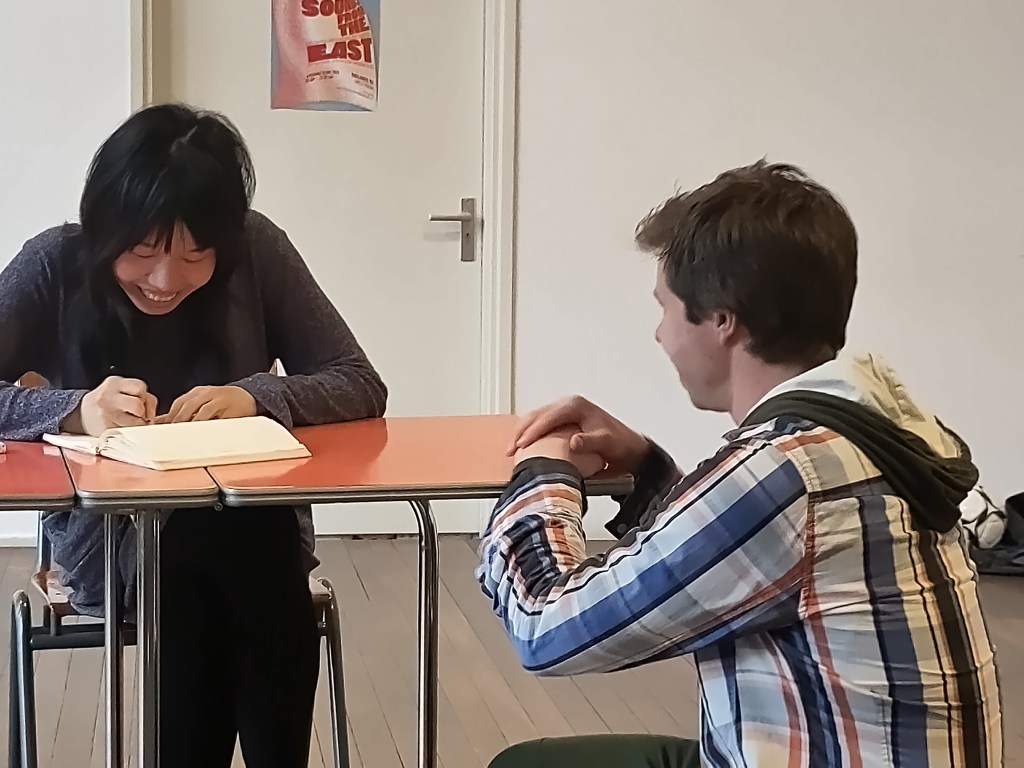
Grace Chang-Byrne and Eli Thorne doing an independent activity exercise.

Meisner & … workshops

I am starting a series of workshops called Meisner & on Saturday 3rd June. This is a series of one-off workshops, usually on Saturdays, exploring Meisner in combination with some other theatre practice. I will work with experts in their field but the focus of the workshops will always be to see how we can apply the pillars of Meisner work – authenticity, improvisation and imagination – to other theatre practices. For this reason, you must have done a Meisner course with me or Meisner training with another teacher to be able to join these workshops.

Meisner & Mask workshop with Grainne Delaney

The first workshop will be Meisner & Mask with me and Grainne Delaney on Saturday 3rd June. To sign up, please click here. It will be held in the wooden room at Tugelaweg 85 and run from 10am to 1pm. Payment is by donation on the day of the workshop.

In this workshop, we will explore how we can bring what we are learning through the Meisner exercises – authenticity, working off each other unanticipated moment to moment, connection to ourselves and our imaginations – and bring that into contact with Mask work, which gives us the freedom to explore the non-verbal, embodied and often unexpressed sides of ourselves.

Short introduction to Mask by Grainne Delaney

Mask has always been seen as a magical medium: a way of embodying qualities, elements, characteristics and transformative Journeying to other worlds. The Mask provides a strong, multi-sensory memory, linked to a unique personal investment in a challenging physical experience.

Working with mask is about following physical impulses rather than rational thoughts. And using the body to show feelings and express emotions rather than words.

When we choose to work with mask we are engaging our whole(istic) sensory system.
 The Mask is a tangible object, a thing to be held,
 The Mask is a visible image to be explored, observed and described,
 The Mask is an Archetype and a pattern of behaviour that is to be embodied, it has a
kinaesthetic posture, movement rhythm and a voice quality.

In this workshop we learn how to ‘read’ a mask and embody a quality, form or direction.
We will work with silence, stillness and scaling to create dynamic interaction.
We will play and tell stories.
We will step into another physical behaviour, and in doing so, we will learn more about ourselves.

Grainne Delaney has a Master’s background in Psychology & Theatre. She uses it to teach communication, pitching and storytelling to corporate beings, and mask, movement, and the Physicality of Voice, (an integration workshop) to Dancers at the Theatre School, Amsterdam.

From a mask workshop run by Grainne Delaney.

Getting personal

It’s such a joy to see people doing the repetition exercise and discovering how a seemingly banal observation can bring out all sorts of reactions in the other person if that person is truly listening and taking it personally. Meisner spoke a lot about taking things personally. In real life, if someone says something that hurts us and we don’t have a very close relationship with them (and sometimes even or especially if we do) we brush it off or pretend it didn’t affect us. We don’t call it out and stand up for ourselves because we’re afraid of conflict and we’re afraid that it will cause us more pain if we really let the hurtful words in.

In acting, we have to learn to take things personally otherwise we won’t ever come alive. Learning to do this is a whole journey and it’s a huge part of what we learn when we first start to do the Meisner exercises. It’s fascinating to see people’s defence mechanisms when they begin, the little tricks they sew together into a full suit of armour: The nervous laughter, the ironic replies and the fake bravado. When you fully commit to the exercises, that armour will start to fall off, bit by bit, leaving you vulnerable and open to your fellow actors and to the power of your own imagination.

Of course, our egos wouldn’t survive the real world without some armour but many adult actors have picked up so much that they struggle to relate to another person unless they can do it through the foil of a character. Meisner exercises teach us to deal with ourselves first. We cannot learn to play characters freely, with access to the whole range of human emotions, if we don’t allow ourselves to experience them first. So many people have said to me “I could never be an actor because I’m no good at hiding my feelings” and yet that is precisely what we need in our actors. Acting is revealing not concealing.

Cultural context also plays a role here. I come from the UK, where a self-deprecating sense of humour is valued and showing emotion in public isn’t. (Of course, I am also 475 and younger generations are definitely more emotionally open.)

So what does taking things personally look like? It means that when someone says something to you in an exercise, you take it as you would if someone really close to you had said it. To give an example, in the course of the repetition exercise one student tells another she is “arrogant”. She is clearly upset by this – we can all see this immediately from her behaviour – but both students then brush it away and the moment is lost. If they acknowledge the fact that one of them has hurt the other, the connection between them will change into another moment and another and another. Imagine if a colleague at work whom you don’t know well calls you arrogant in the course of a meeting. You will probably become defensive or embarrassed and try to walk away as quickly as possible. That evening at home, you might rage about it to a close friend, turn it into a funny story ridiculing your colleague or burst into tears. Either way, you will have some sort of reaction that you only release when it is safe to do so. If however, a family member or very close friend calls you arrogant, you may very well find your reaction comes swiftly and fully. Taking it personally simply means taking it as you would if the person opposite you has great emotional significance to you. The beauty of this is that once you accept that magic “as if”, it will become true. Our fellow players are genuinely the most significant people to us in the moments we are connecting with them.

Other thoughts that have come up in my classes recently include how important it is to tell actors when they are getting it right. I remember one play in which I got incredibly hung up on not feeling ready to burst into tears at the moment I was meant to. The irony was that every time I got to this point in the play, I was feeling absolutely miserable – which was exactly what I was supposed to be feeling. But instead of just allowing that to be, I would go up into my head and tell myself that the reason I was miserable was that I was a terrible actor, instead of recognising that the emotions came from the imaginary circumstances and staying with them. Unfortunately, in that case the director wasn’t able to help me with this. Meisner student and American playwright David Mamet talks about exactly this in his wonderful book True and False. It is very instructive to recognise that when you feel frustrated or hurt or hyper during rehearsals or film shoots that those emotions are almost certainly coming from connection to the material you are working on. We are very suggestible as actors but we are also very self-critical, which stops us from just allowing ourselves to be.

Another observation from teaching my workshop in Berlin last week (of which more in another post) is that the energy of a person who is hiding their emotions can have a very negative effect on the rest of the group. Feeling sad or angry when you come in to class isn’t the issue. These emotions have a tangible effect on our behaviour and as long as we acknowledge them, they can also change. Hiding our emotions however takes a lot of energy so that there is no energy left to be open to others and change. At the start of all my classes and rehearsals, we always sit in a circle and have a moment to share how we feel in that moment. Sometimes we comment on each other’s contributions but mostly we just listen. It’s Very Therapy. I keep expecting someone to rebel but so far everyone has always leaned into it, although some people find it harder than others. Still, even those people get into it eventually. It’s a simple way to figure out what you’re feeling so you can get on with what you’re doing and not constantly be in your head trying to deal with it or stop it from getting out in a Don’t Mention The War sort of way.

I also did a spoof voiceover for Fossielvrij Kultur, a wonderful group that stages performance art or artivism to get art institutions to stop accepting sponsorship from fossil fuel companies like BP and Shell or the big banks that bankroll them (looking at you, HSBC, Barclays and ING). It was one of the most satisfying voice-over jobs I’ve done for a while as I was able to bring my voice work and activism together. (In the absence of a Meisner actor to call bullshit on “my activism” I will have to do it myself and point out that it has been far too long since I joined my XR crew on the streets. I intend to correct this at the first opportunity.)

Tonight I will be working on my devised project again with one of my acting groups before our show next week. We are absolutely 100 percent not ready and have no idea what will happen. And so it must be.

Here are some photos of the wonderful Joanna Lucas and Anna Anning stalking each other emotionally.