
Courses
The next one-week intensive foundation course will run from Wednesday 29th April – to Sunday 3rd May 2026 from 10:00 to 16:00 on Monday, Wednesday and Thursday and until 17:00 on Tuesday and Friday. It will take place at OT301. This course will move at a fast pace and is intended for committed students with some acting training and/or experience. To sign up for it, please click here.
The cost for the course is €415 or €365 if you pay 27th February. Payment by instalment is available on request. You may also be eligible for a grant that will cover up to 40 percent of the cost – contact me for details.
To sign up for an online interview, please click here.
The next one-week intermediate course will run from Monday 18th to 22nd May, class times and location are the same as for the foundation course. This course is now fully booked but you are welcome to join the waiting list – just message me.
The next advanced course will start in January 2026, details to be announced. Please let me know if you are interested.
I also give private coaching classes in Amsterdam and surrounding areas. I can help you prepare for an audition, a part you’ve already booked or a meeting with a casting director or agent. I currently charge €70 for one hour of coaching within Amsterdam. If you are a current student of mine, you will get a discount. Get in touch with me and let me know what you need.
The practical part
Please note that you can only sign up for a foundation course if you have already done a taster class with me or will do an online introduction before the start of the course. To sign up for the course, or to arrange an online introduction, please click here.
If you have done Meisner training with me or somewhere else up to intermediate level and are interested in the possibility of an advanced course with the opportunity of meeting industry professionals, please let me know in the form. This is for people who are either already pursuing acting professionally or are committed to it.
If you want to register your interest in new courses and taster classes, drop me a line so I can update you by email.
PLEASE NOTE: You will get a confirmation email or an email saying the class is full. If you don’t receive an email within a few days of signing up, please check your spam folder. If you still don’t see one, please contact me!
The what’s it all about part
Sanford Meisner’s definition of acting was “living truthfully under imaginary circumstances”. Meisner believed that to achieve the ability to engage in truthful behaviour while immersed in an imagined reality the actor must learn to really listen, really observe and really do. Acting classes and directors often put so much emphasis on text work that actors can become disembodied, talking heads who are unable to really listen and respond to either their fellow actors, their own instincts or even the text.
“Act before you think – your instincts are more honest than your thoughts.”
Meisner said that “the foundation of acting is the reality of doing.” Meisner exercises are designed to get you out of your head and into your body. You will learn to unlearn the socialisation that teaches us to ignore our first impulses and to trust them instead. In other words, you will learn how to be free, spontaneous and playful – and to connect. Through the exercises of the technique, you’ll practice truly listening, observing and responding to both your fellow actors and your inner selves.
So, who was this Meisner character?

Sanford Meisner (1905 – 1997) was an American-born actor and teacher who had a troubled childhood. He trained as a pianist and actor and later worked with Stella Adler and Lee Strasberg, among others, at the Group Theatre in New York in the 1930s. Inspired by the work of Konstantin Stanislavski, the group consisted of writers, actors and directors. Through their work, they began to develop acting techniques to enable actors to create authentic performances. Lee Strasberg’s Method is perhaps the most famous of these techniques today. In the 1930s, Adler and Meisner broke away from Strasberg’s use of Stanislavski’s writings on affective memory (as Stanislavski himself did in his later years), feeling that Strasberg’s reliance on emotional recall was damaging and unsustainable for many actors. Meisner went on to develop his own method, now known as Meisner technique, to help actors achieve the authenticity and life at the heart of all great performances.
How can Meisner make me a better actor?
To unlearn bad habits and become capable of spontaneous and authentic responses, we must practice the skill of “really doing” with our fellow actors. Once we have mastered this, we can learn how to engage in imagined circumstances in a way that makes sense to us as individuals so that, once we’re performing, we only have to be in the moment. In this way, not only do we become more authentic and alive, we also connect to our own unique way of being, which is what makes each individual actor interesting to watch.
Meisner developed several exercises to help the actor develop these sets of skills. The first and core exercise is called the repetition exercise. Actors work in pairs using simple observations about their scene partners to establish an authentic connection. This goes through three stages:
Objective repetition without changes where you learn to really listen and repeat exactly what the other person says. This exercise demands that you honour your first impulse and do not attempt to censor yourself. The first actor to speak says the first thing that comes into their head; this is usually a very basic observation. The second actor then repeats what they just heard. This act of repetition means the two of you don’t have to worry about what you’re going to say next and allows you to stay focussed on each other. When we repeat, we do not try to change the words or put line-readings on them. But we respond in our own way, allowing our voices and bodies to reveal whatever they do about what the words mean to us, even if that is nothing. It is not the what that matters but the how. The repetition exercise frees us from the need to pretend to have a response, but we must also learn not to hide our responses, which can be very hard.
Objective repetition with changes This next stage is about allowing the repetition to change when we or our partners are changed – and not before. The more we are in connection with the other person and on the effect they have on us, the quicker this will happen. We learn to allow ourselves to be changed rather than forcing change upon the other. American playwright David Mamet’s writes in his book True and False “invent nothing, deny nothing, speak up, stand up …”. (What comes after the ellipsis is “stay out of school” – but that’s a story for another day.)
“What you do doesn’t depend on you; it depends on the other fellow.”
Subjective repetition with changes This final stage of repetition is when actors become so connected that they start to speak from their own point of view. In practice, this means they will say something that comes from their own perception of the situation. For example, if the other actor seems to be moved by something that has just happened, you respond to that, even if the other actor perceives it differently.
Click here to see Meisner teaching the repetition exercise. This was filmed late in his life when he had had operations on his throat for cancer. He is speaking through a special machine. This particular exercise is called the three-moment game where the first partner starts by saying something deliberately provocative to the second partner and then works off the second partner’s reaction, whatever it is. It is designed to make crystal clear the process of listening, responding and working off what you get in the moment. Once you get the hang of this, you will learn to work off whatever you get in the moment, including the subtlest, micro changes in your partner and yourself, and to be able to go wherever those moments take you.
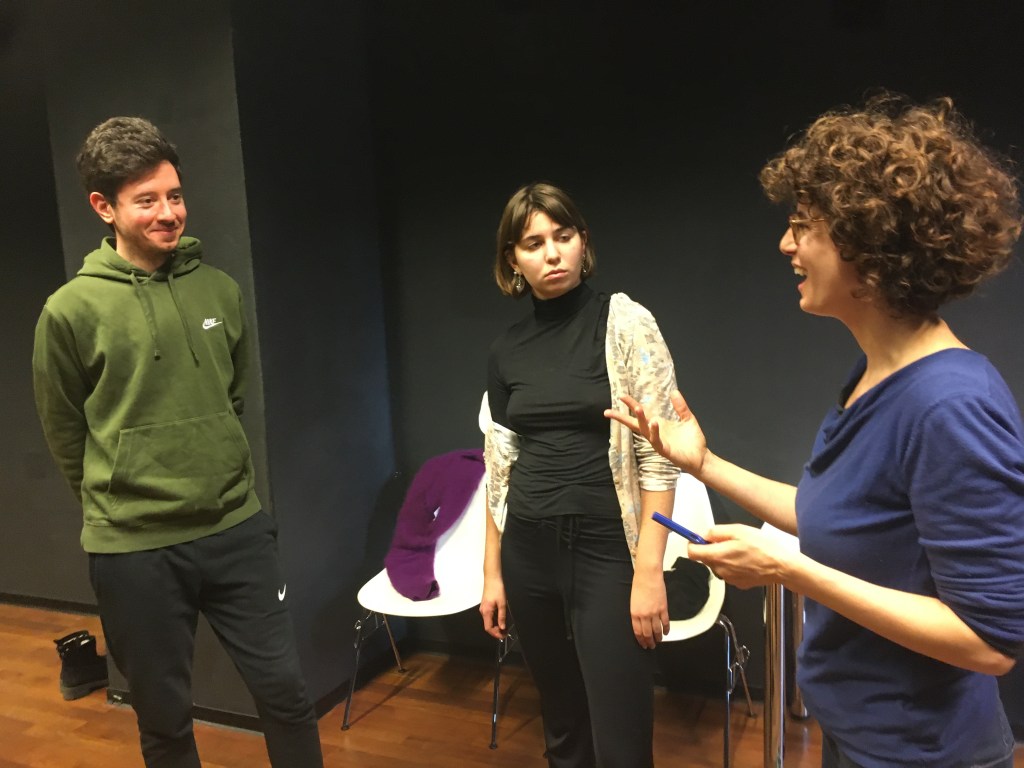
Intro to Meisner workshop, Berlin
“Acting is behaviour.”
When you are truly present and in your body, you will find that your whole body becomes more expressive. When you are moved, often you will literally move and behave in ways that are surprising. You learn to experience the space you are in as an extension of yourself and your scene partner. When we come to do scene work, the physical freedom that we have found through doing the repetition exercise will become invaluable.
As actors, we want to come away from a class knowing we have learned something we can apply when we are outside class. If you show up and do the work, you’ll walk away with a set of skills you can apply almost immediately to every acting situation.

Independent activity class, Berlin
Who are the classes for?
The classes are intended for actors at any stage of their training, including those with no previous experience of Meisner technique. Please note that the classes will be taught in English, but it is always possible to work in Dutch (or another language) with your scene partners if that’s easier for you.
Non-actors curious to see what the technique is about are very welcome to audit the class for a reduced price. Please let me know this is what you want when you book.
What will a Meisner technique class be like?
Classes will be open to a minimum of six and a maximum of ten students so that everyone gets plenty of time on their feet. Observing others is also part of the learning process and you will be encouraged to comment, ask questions and make notes. You will work mostly in pairs. Classes usually last three hours.
Class will always start with a simple movement technique and a voice release exercise to make sure you are completely connected to your whole self. We will then move on to the repetition exercise, the core of Meisner technique. Through the various stages of the exercise, you will learn to truly listen to and observe both your fellow actors and your inner selves. This exercise is the bedrock for all the later exercises, such as Knock on the Door, Independent Activity and Emotional Preparation and, finally, scene work, and can be returned to again and again.
These classes will be accessible but also demanding. Meisner technique requires you to get to know yourself, your acting tics, your vulnerabilities and your defence mechanisms. This can be confronting, but as you do the exercises, you will quickly understand why this matters and experience the benefits of doing the work.
Meisner technique demands something very simple of the actor: To connect to their authentic selves and to their fellow actors. Like all simple things, this takes time, practice and dedication. Commit to the work and you will grow, not only as an actor, but as a human being.
Follow me on Instagram.
Follow me on Facebook.
 Leila Gray
Hello,
I am contacting you because I would be really interested to the evening or weekend classes. Would it be possible to be updated in case any opportunity like this came up? Thank you!
Robi
LikeLiked by 1 person